Theory of Operation
Block Diagram
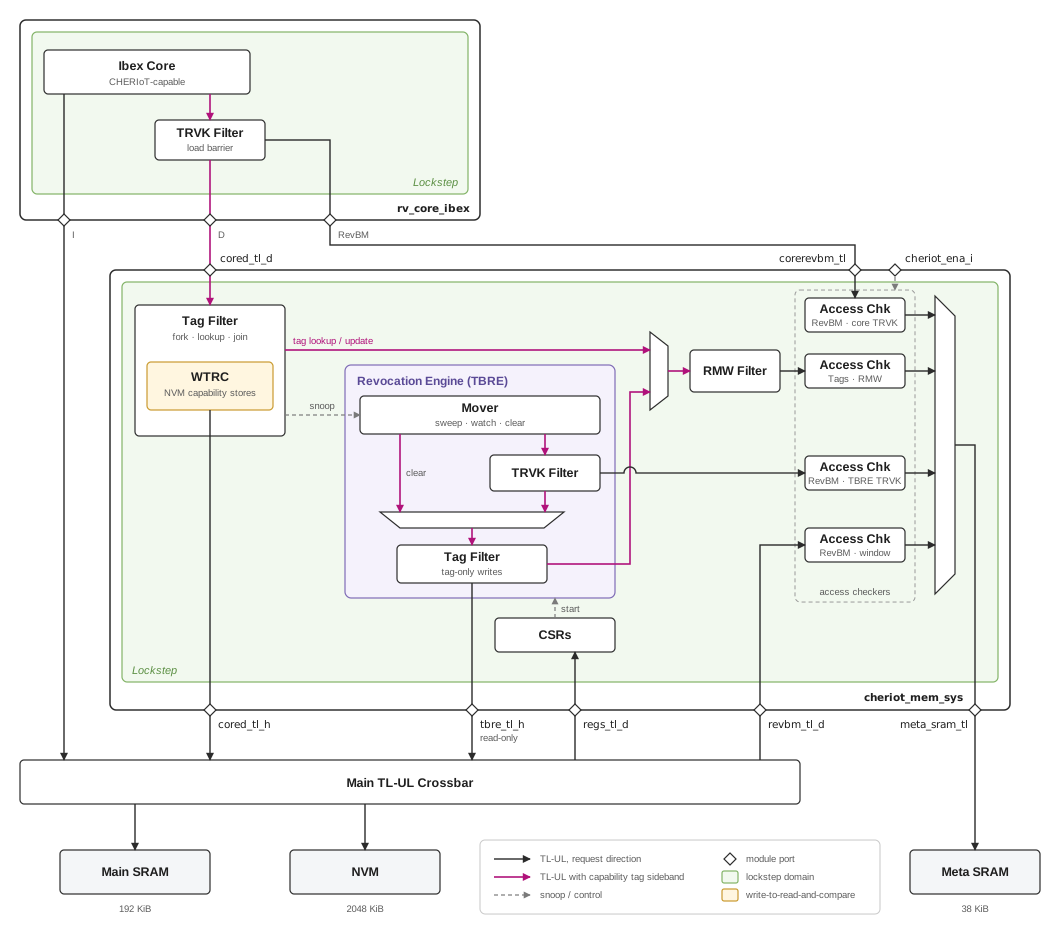
| Port | Direction | Peer | Purpose |
|---|---|---|---|
cored_tl_d | device | rv_core_ibex | Core data accesses with the capability tag support. |
cored_tl_h | host | xbar_main | The data half of the access, forwarded to SRAM, NVM and peripherals. |
tbre_tl_h | host | xbar_main | Read-only port of the revocation engine towards the memories holding capabilities, the SRAMs and the NVM. |
corerevbm_tl | device | rv_core_ibex | Revocation bitmap reads from the core’s TRVK filter. |
revbm_tl_d | device | xbar_main | Memory window through which software reads and writes the revocation bitmap. |
regs_tl_d | device | xbar_main | CSR interface. |
meta_sram_tl | host | sram_ctrl_meta | The single port into the unified meta SRAM. |
cheriot_ena_i selects the execution mode. It is a mubi4_t driven by the write-once mode switch in
rv_core_ibex.
Metadata Encoding
Two kinds of metadata are stored, both at bit granularity, both packed into 32-bit words:
| Metadata | Covered by one bit | Covered by one 32-bit word |
|---|---|---|
| Capability tag | one 8-byte capability | 256 bytes of data |
| Revocation bit | 8 heap bytes | 256 heap bytes |
Meta SRAM Address Map
The map is derived from the address-map parameters, so it changes with the covered region sizes.
For Earl Grey - 192 KiB main SRAM at 0x1000_0000, 2 MiB NVM at 0x3000_0000, meta SRAM at
0x1100_0000 - it is:
| Offset | Size | Region | Reachable from |
|---|---|---|---|
0x0000 | 3 KiB | Main SRAM revocation bitmap | revbm_tl_d, corerevbm_tl, revocation engine |
0x0C00 | 32 KiB | NVM capability tags | RMW filter |
0x8C00 | 3 KiB | Main SRAM capability tags | RMW filter |
0x9800 | - | top | - |
The revocation bitmap is situated at the base of the meta SRAM.
The revbm window and the meta SRAM’s own RAM interface consequently share a base address; the
window is the software-visible view of the first region, the RAM interface is only reachable from
meta_sram_tl.
In the revbm window, bit b of word w covers the eight heap bytes starting at
MainSramBaseAddr + (w * 32 + b) * 8, setting it marks that granule as revoked. Accesses must be
full 32-bit words, and the window returns a TL-UL error while the system is in ePMP mode.
Datapath
Tag Filter
The tag filter forks each core data access into up to three streams, the host port, the meta port, and a small metadata FIFO that carries information from the request to the response channel. After receiving the responses, the streams are joined together and the data response is returned to the core.
A meta lookup is needed when CHERIoT mode is enabled, the access targets memory capable of holding capabilities, and either:
- the access is a 64-bit-aligned read that the core hints as a capability load.
- the access is a write, of any kind.
Writes always look up because a non-capability store must clear the tag of the location it overwrites. The exception is a capability store to the NVM, which the WTRC verifies (below): it is not looked up, and only its second word writes the tag, once the store is verified.
The returned tag is sticky across the two words of a capability: on a response whose FIFO entry was marked aligned, the tag read from the meta SRAM is presented and captured; on the following unaligned response the captured value is presented again and then cleared. This is what lets a 65-bit capability arrive over two 32-bit responses with one combined validity tag bit. Only read responses take part: a write answered between the two words of a capability is returned untagged and leaves the captured value alone.
The FIFO depth sets the number of outstanding transactions the filter supports. It is two for the
core’s tag filter, matching Ibex’s LSU, which never issues more than two outstanding split-access
halves, and the revocation engine’s number of words in flight for its tag filter. Error
responses from either the host or the meta path are merged into d_error towards the core. A
meta error on an error-free host response sets d_error and updates the response integrity by the
difference that makes; the code is linear, so a correct integrity stays correct and a broken one
stays broken.
The meta response is accepted into a buffer, and the join consumes it from there. The fork hands
out its three streams independently, so it can issue one lookup while the metadata FIFO is full.
At most one lookup more than the FIFO depth is therefore unjoined, and the buffer is one entry
deeper than the FIFO, so it never refuses a response (MetaRspAlwaysAccepted_A). The meta path
therefore never waits for a data response: with two tag filters sharing the RMW filter, and the
data paths of both reaching the same in-order SRAMs, a meta response held until its data response
arrives could wait on a data response that is itself queued behind the other tag filter’s.
A write forks into its data write and its tag update independently. If one of them fails, the core
receives d_error, but the other half is not undone: a failed data write still updates the tag, and
a failed tag update leaves the old tag next to the new data. Software must treat a location whose
store was answered with an error as holding a stale tag. A capability store to the NVM is the
exception: its tag is only written once the store is verified.
Write-to-Read-and-Compare Filter (WTRC)
The NVM cannot be written through the interconnect, but a capability held in the NVM must be able to
carry a valid tag. The core’s tag filter is therefore built with NvmCapStores, which places
cheriot_wtrc on its host port. A capability store to the NVM - a write in strict CHERIoT mode to
the NVM with the tag sideband set, is not written: it is turned into a Get of the word it targets,
with recomputed command integrity, and succeeds only if the NVM already holds its data and data
integrity. It does no lookup. Every other access passes through the WTRC unchanged and with
unchanged timing; the revocation engine’s tag filter has no WTRC.
The core stores a capability as two words, W0 at the lower and then W1 at the upper address, and issues nothing else until W1 is answered. The WTRC keeps each request’s data and data integrity in an expect FIFO, which is written when the tag filter takes the request, and compares them with the NVM’s response:
| Word | Answer |
|---|---|
| W0 | AccessAck; d_error if the NVM read failed, the store is not a full-word PutFullData, is out of sequence, or its data or data integrity differ from the NVM’s. |
| W1 | If W1 and W0 both matched, W1’s NVM response turns into the capability’s tag write towards the meta port (ahead of any lookup); the tag filter joins a local AccessAck with the tag write’s response, so W1 carries its error. Otherwise AccessAck with d_error, and no tag write. |
A capability store that fails leaves the tag as it was and changes nothing else. Its answer is a bus error, never an alert: software can store anything to the NVM.
A four-state FSM tracks the capability being stored and its address, so that W1 is only verified together with the W0 of the same capability:
| State | Meaning | Out of sequence |
|---|---|---|
CapIdle | no capability open | a W1 |
CapW0 | W0 taken, waiting for its W1 | anything but the W1 of the same capability |
CapW1 | W1 taken, neither answered nor turned into a tag write yet | a W1, or any request before W1 is answered |
CapTagWr | W1’s tag write issued, waiting for its answer | a W1, or a W0 before W1 is answered |
A W0 taken always opens a capability, and W1’s answer closes it; the next W0 may be taken in the cycle W1 is answered.
The WTRC raises fatal_fault only for what the core cannot produce: a bad command or data
integrity of a capability store (checked before the WTRC recomputes the command integrity), a bad
response integrity of the NVM’s answer to one (checked before the WTRC builds its own answer), a
partial capability store, and a request out of the capability sequence. In CapW1 a request is
out of sequence as soon as it is presented: the tag filter hands its lookup to the meta port when it
is presented, so the lookup could reach the meta port before W1’s tag write. Ibex cannot present
one, and NoReqBeforeTagWr_A asserts it.
RMW Filter
Because tags are bit-granular, a tag write cannot be a plain TL-UL write. The RMW filter turns each access into meta SRAM traffic with a four-state FSM:
| State | Behaviour |
|---|---|
Passthrough | A read is forwarded and the tag bit is picked out of the response word. A write is turned into a Get of the meta word and the FSM advances to Fill. |
Fill | The meta word arrives. If the stored tag bit already equals the tag to be written, the read response is converted into an AccessAck towards the core and the FSM returns to Passthrough. Otherwise the word is captured, the bit is modified, and the FSM advances. |
WriteBackReq | The modified word is written back with PutFullData and freshly computed command and data integrity. |
WriteBackAck | The write response is forwarded to the core and the FSM returns to Passthrough. |
Skipping the write-back is the common case and keeps pressure off the shared meta SRAM: it costs one meta SRAM read per 32-bit store, and a read plus a write only when the tag actually changes.
The filter checks the response integrity and response data integrity of every meta SRAM response
and separately reports d_error.
The filter holds the state of a single operation, so it takes a new request only while no
operation is unanswered, or in the cycle a read is answered. This keeps back-to-back reads at one
per cycle, at the cost of a combinational path from a meta SRAM response to the acceptance of the
next request. The meta SRAM reads and writes it issues for a write carry the requester’s
a_source, so every answer returns to the tag filter that sent the request.
The RMW filter serves two tag filters, the core’s and the revocation engine’s: a cheriot_socket_m1
arbitrates their meta ports, carrying the tag and bit select sideband, onto the single RMW filter,
so every tag update of the subsystem goes through one read-modify-write.
Revocation Engine
A write of 1 to TBRE_START starts a sweep over TBRE_NUM_CAPS capabilities from
TBRE_BASE_ADDR, if TBRE_NUM_CAPS is not zero, TBRE_BASE_ADDR lies in a tagged region
(MainSramBaseAddr up to MainSramTopAddr, or NvmBaseAddr up to NvmTopAddr), and the subsystem
is in CHERIoT mode (a strict
MuBi4True on cheriot_ena_i). Any other start is ignored and leaves TBRE_STATUS.busy and
TBRE_REGWEN unchanged and sets TBRE_STATUS.start_err, which stays set until software writes 1 to
it.
While the engine is active, from the cycle after a taken start until every capability of the sweep
is resolved, TBRE_REGWEN is low and locks the three registers; TBRE_STATUS.busy follows one
cycle later. The register interface takes a request at most every other cycle, so a read issued
right after a start already sees the sweep in both. When the engine stops being active, the
tbre_done interrupt is raised.
TBRE_EPOCH: bit 0 is set while the engine is active, in the same cycle as TBRE_REGWEN is low,
and bits 31:1 count the sweeps that ended without an error, incremented in the cycle bit 0 clears,
so the epoch goes straight from the odd value to the next even one. A sweep during which any error
sets TBRE_STATUS.sweep_err is not counted, so the epoch returns to the even value it had before
that start: software that releases memory once the epoch shows a completed sweep never does so on a
sweep that may have left a revoked capability tagged.
Ignored starts and starts written while the engine is active leave the epoch unchanged.
The engine reads both words of every capability with the capability-load hint, through a TRVK
filter of its own and a tag filter of its own, over tbre_tl_h. Up to two words are in flight,
each read with a source ID of its own. The TRVK filter only sees these reads: a socket merges its
downstream port with the engine’s tag clears in front of the tag filter. The TRVK filter
applies the load barrier: a tagged capability that is not a sealing capability and whose base has
its revocation bit set is revoked, and so is one whose bitmap lookup fails. For every revoked
capability the engine clears the tag through its tag filter, which never forwards a write to
tbre_tl_h: the engine does not modify memory data.
The core may write a capability while the engine resolves it. The subsystem watches every write the
core presents on cored_tl_d, and every write it accepted there until the write is answered, as the
data of an accepted write may still be on its way to memory. It compares them with the capabilities
the engine has in flight, at capability granularity; a clear for a capability the core wrote in the
meantime would remove the tag of what the core wrote. The watch starts when the engine presents the
read of the capability’s lower word, and a capability written from then on until its clear is
presented is not cleared.
From the presentation of the clear until it reaches the RMW filter, a core write to the same
capability marks the clear stale, and the RMW filter then only reads the tag word instead of
clearing the tag. Once the clear is at the RMW filter, the socket in front of the RMW filter holds
it there, so no core write reaches the RMW filter before it. Writes of other crossbar hosts, such as
the debug module’s system bus access, are not watched.
A sweep that would reach past the top of its region ends there: the engine sweeps
min(TBRE_NUM_CAPS, (top - TBRE_BASE_ADDR) / 8) capabilities, with top the MainSramTopAddr or
NvmTopAddr of the region TBRE_BASE_ADDR lies in, and TBRE_NUM_CAPS keeps the value software
wrote. A sweep therefore never leaves the tagged region it starts in.
Access Checkers
Each of the four requesters passes an access checker parameterized with the region it owns. An access is forwarded only if all of the following hold:
cheriot_ena_iisMuBi4True.- The address is inside the allowable region for the requester.
- The address is word-aligned and the access is a full 32-bit word.
- The opcode is
GetorPutFullData.
Everything else is steered to a tlul_err_resp instance and answered with a TL-UL error. In
particular, any cheriot_ena_i value other than a strict MuBi4True - including a strict
MuBi4False - makes the entire meta SRAM inaccessible from all four ports.
Arbitration
A tlul_socket_m1 arbitrates the four checked streams onto meta_sram_tl. Arbitration sits behind
the checkers, on transactions that are already integrity-protected end to end.
System Bus Access
The debug module’s system bus access (SBA) port is a crossbar host of its own and does not pass through the tag filter, so none of the datapath above applies to it. SBA remains available in CHERIoT mode if the life cycle state allows debug, but:
- reads and writes go straight to memory without any CHERIoT checks.
- writes do not clear the capability tag of the location they overwrite.
Debug accesses in CHERIoT-mode MUST therefore be performed through Ibex and not through SBA.
Error Handling
The subsystem distinguishes a denied access from a fault:
| Cause | Result |
|---|---|
| Any meta SRAM access while in ePMP mode | TL-UL error response, merged into d_error towards the core |
| Access outside the region owned by the requesting port | TL-UL error response |
PutPartialData to the meta SRAM | TL-UL error response |
| Device error on the tag path | Read-modify-write aborted, d_error towards the core, and fatal_fault alert |
Integrity fault on a meta SRAM response (rsp_intg or data_intg) | fatal_fault alert |
| Integrity fault on the CSR interface | fatal_fault alert |
| Capability store to the NVM that does not match the NVM contents, or whose NVM read fails | d_error towards the core, tag unchanged |
Capability store to the NVM with a bad command or data integrity, a bad NVM response integrity, not a full-word PutFullData, or out of the W0-W1 sequence | d_error towards the core, tag unchanged, and fatal_fault alert |
| Any other request out of the W0-W1 sequence of a capability store to the NVM | fatal_fault alert |
| Error response to a read of the revocation engine | Word not cleared, TBRE_STATUS.sweep_err |
| Any other error, or an integrity fault, on a response to the revocation engine | TBRE_STATUS.sweep_err and fatal_fault alert |
| Error, integrity fault or malformed response on a revocation engine bitmap lookup | Capability counted as revoked, TBRE_STATUS.sweep_err and fatal_fault alert |
| RMW filter fault while the revocation engine is active | TBRE_STATUS.sweep_err and fatal_fault alert |
The first three, and a capability store to the NVM that does not match or whose NVM read fails, are reachable by software and surface as a bus fault in the core, and an error response to a read of the revocation engine, e.g. of a read-protected NVM page, only fails the sweep; none of them raises an alert. The others latch the fatal alert until reset; a sweep that could not be completed correctly must not look successful.
Timing
All internal sockets and the socket towards the meta SRAM are instantiated with zero-depth FIFOs, so
a request propagates combinationally from cored_tl_d through the tag filter, the
cheriot_socket_m1 in front of the RMW filter, the RMW filter, access checker and arbiter to
meta_sram_tl, and the response propagates back the same way. The revocation engine’s tag filter
joins the same path at the cheriot_socket_m1, and its TRVK filter reaches meta_sram_tl through
its own access checker. This keeps the latency overhead of CHERIoT mode at zero cycles for reads,
but places the meta SRAM path on the critical path.
The design provisions optional pipeline cuts in front of the access checkers to break that path, at the cost of two extra cycles per meta SRAM access. They are not implemented yet.
A capability store to the NVM takes longer than one to the SRAM: W1’s tag write is only issued once W1’s NVM read has returned, instead of in parallel with the data write, so W1 is answered one NVM read latency later.